Your Year in 60 Minutes: The Annual Replay Experience
Sometime near the end of the year — or the beginning of the next one — you’ll have the option to do something most people have never done.
You’ll press play on January. And then you’ll sit with your own voice for an hour, moving through twelve months of your life, ten seconds at a time.
This is what the Annual replay experience is. Not a highlight reel. Not a curated collection of your best moments. Every day you recorded, in order, from the first entry to the last — the ordinary Tuesdays and the difficult Fridays and the quiet Sunday mornings that felt like nothing at the time and now feel like everything.
What You’re Actually Listening To
Before getting into the experience itself, it’s worth being precise about what an annual queue contains.
If you’ve recorded every day for a year, you have 365 entries. Each one is ten seconds. That’s 3,650 seconds of audio — just over sixty minutes of your own voice, captured across 365 separate moments.
Most people won’t have recorded every single day. Life interrupts. The habit breaks and restarts. A realistic annual archive might contain 200, 250, maybe 300 entries — somewhere between thirty and fifty minutes of audio, with natural gaps where the days went unrecorded.
What you won’t find is a polished narrative. No editing. No curation. No selection of the moments worth keeping. What you will find is something rarer: an honest cross-section of a year, captured in real time, before you knew which moments would matter and which ones wouldn’t.
That’s the archive. An hour — give or take — of who you actually were.
How the Annual Queue Works
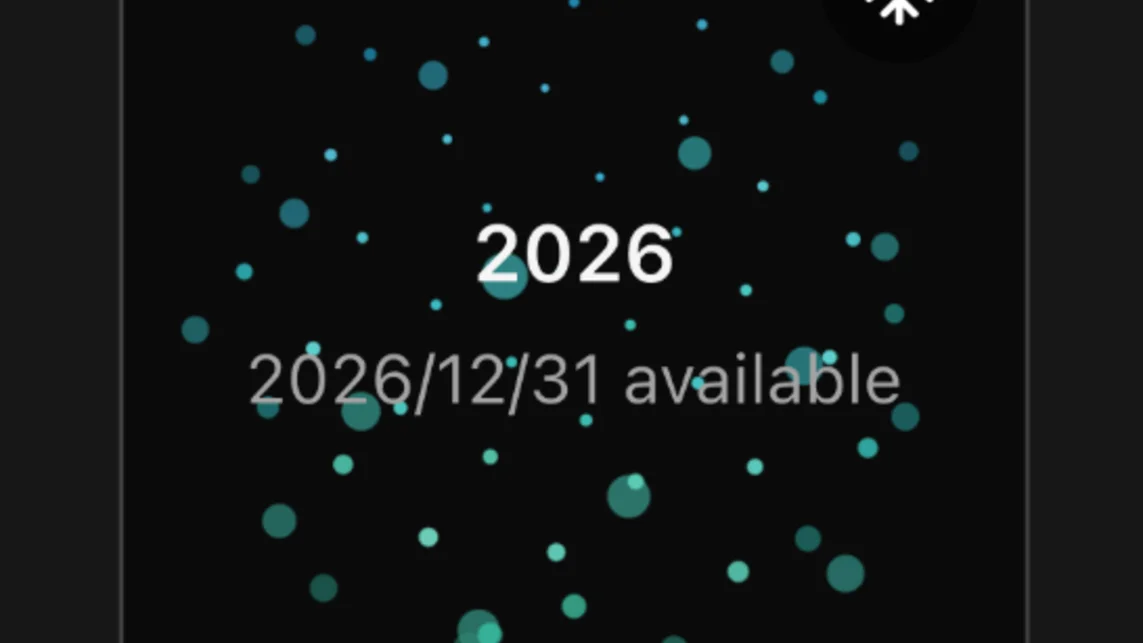
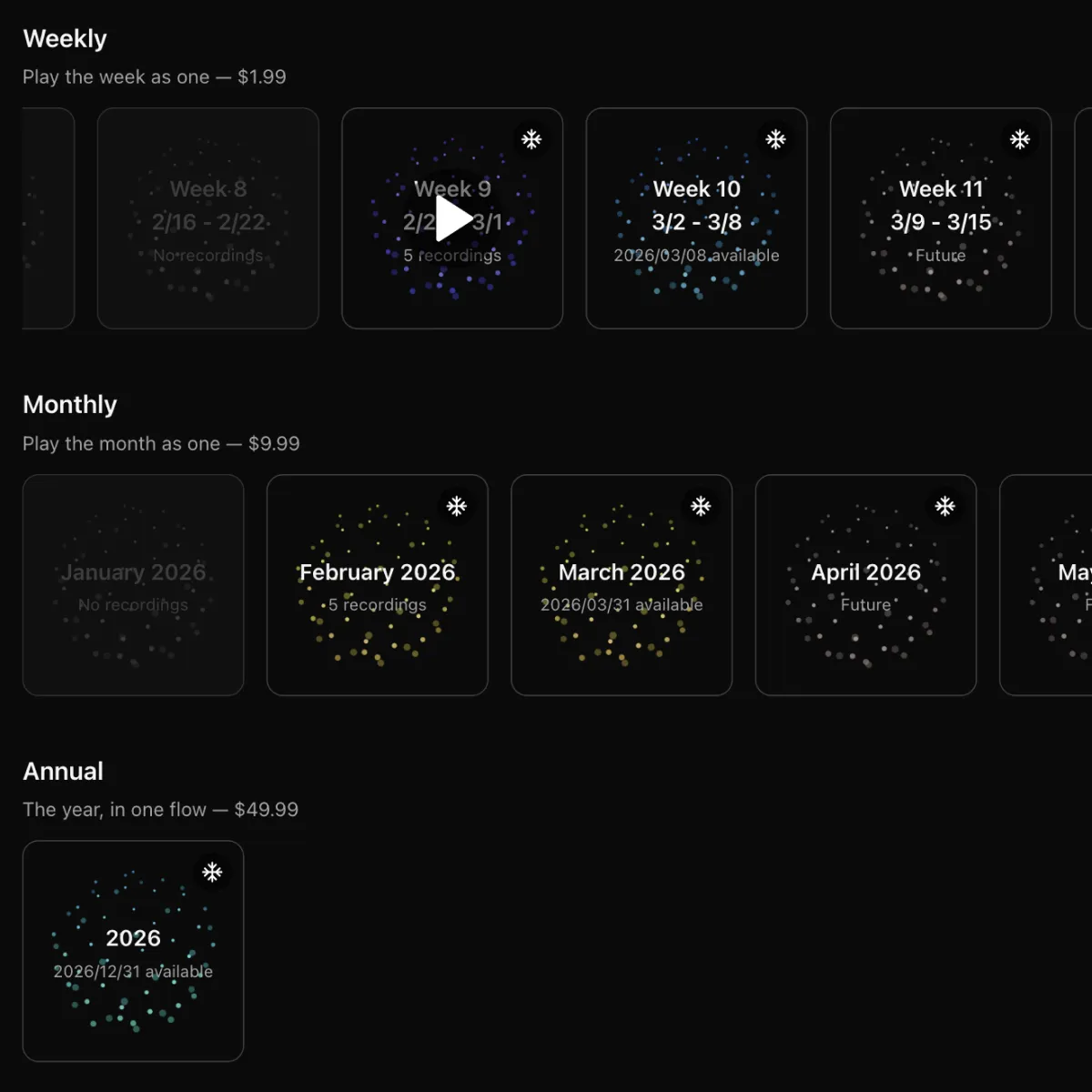
Open the calendar from the main screen and scroll down past the calendar view to the Your days. In order. section. With an Annual Memory Plan unlocked, you’ll see the year card — a preview of the sphere cluster from your entire year, the collective emotional texture of twelve months rendered as a single visual.
Tap the card to begin.
The playback screen is the same one you use for individual entries. There’s no special interface for the annual queue — no progress bar showing “Day 47 of 298,” no chapter markers, no timestamps floating over the sphere. Just the sphere itself, and your voice, and the date of the entry currently playing displayed at the center.
The queue moves through your entries automatically. One recording ends, the next begins. The sphere shifts — color changing, movement changing — as each new entry plays. You can pause, skip forward, skip back. Otherwise, it simply continues.
This simplicity is intentional. A more complex interface would give you something to manage. The annual queue gives you something to experience.
What the Experience Actually Feels Like
It’s difficult to describe accurately without sounding like an overstatement. So here’s an attempt at an honest account.
The first few entries feel ordinary. You hear yourself from January — wherever you were, whatever was happening then. Your voice sounds slightly unfamiliar, the way your own voice always does in a recording. You might not even remember the specific moment.
Somewhere around the second or third week of listening, something shifts.
You start to hear patterns you couldn’t see from inside the year. A stretch of entries where your voice is slower, flatter, less energetic — a period you remember as fine, but that clearly wasn’t entirely fine. A week where something lifted. The specific quality of your voice on a day you’d forgotten completely until you heard it again.
The sphere changes with each entry. A calm, unhurried day produces a sphere that moves differently than a tense one. An animated, high-energy recording looks different from a quiet, subdued one. Over the course of an hour, you watch your year rendered visually — not as data, not as a mood chart, but as something closer to a portrait.
By the time you reach the later months, you’re listening differently than you were at the start. You know this person. You’ve heard them across seasons, across moods, across the full range of what a year actually contains. The last few entries — whenever they fall, December or whenever you’re listening — land with a weight that earlier entries didn’t have.
Not because anything dramatic happens. Because you’ve been paying attention for an hour, and attention changes what you hear.
Why an Hour Is the Right Length
Sixty minutes sounds like a long time to sit with voice recordings. In practice, it doesn’t feel that way.
Written journals require active engagement — your eyes moving, your brain processing language, your attention doing work. Listening is different. You can be still. You can close your eyes. You can let the entries come to you rather than going to them.
The annual queue works best when you treat it like listening to an album rather than reading a book. You don’t have to do anything except be present. The sphere gives your eyes something to rest on. Your voice does the rest.
Some people listen in one sitting — an evening, a quiet Sunday, a deliberate hour set aside at the end of the year. Others listen in shorter stretches, pausing and returning over several days. Both approaches work. The queue holds your place either way.
What doesn’t work well is treating it as background audio. The annual replay isn’t designed to accompany other tasks. It’s designed to be the task — an hour of genuine attention to the person you were across twelve months. That hour is worth protecting.
When to Do It
The most natural moment for the annual replay is the transition between years — the last week of December or the first week of January, when reflection on the past year feels appropriate rather than arbitrary.
But there’s no rule. Some people do it at the six-month mark, halfway through the year, as a kind of checkpoint. Others wait until they have enough entries to make the queue feel substantial — a few months in, when the archive has accumulated enough texture to be worth an extended listen.
The annual plan unlocks the full year regardless of when you purchase it, so you’re not constrained to a specific window. Your entries from February are just as accessible in November as they are in January.
One approach worth considering: the annual replay as a birthday practice. Once a year, on the same day, listen back to the previous twelve months. Not as a productivity exercise or a self-improvement ritual — as an act of attention to your own life, to the version of yourself that existed before this birthday and won’t exist in quite the same form again.
What You’ll Notice That You Didn’t Expect
Everyone who does the annual replay notices something they didn’t anticipate. A few patterns that come up consistently:
The ordinary days are the ones that matter most. You might expect the entries from big moments — a trip, a significant event, a difficult week — to be the most affecting. Often they’re not. The mundane entries, the ones recorded on unremarkable days when nothing particular was happening, end up carrying the most weight. They’re the texture of the year, not the highlights.
Your voice changes more than you think. Not your voice itself — the quality of how you speak. The pace, the energy, the degree of hesitation or confidence. Listening across a year, you hear these shifts in ways that are impossible to notice day to day.
You’ll hear things you’d completely forgotten. Not just events or facts, but emotional states. A version of yourself that was worried about something that turned out fine. A period of unexpected calm you’d forgotten existed. The specific quality of a week that mattered, recalled not through memory but through the evidence of your own voice.
Gaps mean something too. The days you didn’t record are visible in the queue — not as silence, but as absence. A stretch of missed days tells a story about that period, even without audio. Sometimes the gap is just a busy week. Sometimes it marks something worth noticing.
Your Next Step
If you’ve been recording for at least a few months, you already have the beginning of something worth listening back to.
The Annual plan unlocks the full year whenever you’re ready — there’s no expiration, no deadline for when to listen. Buy it at the end of the year when the archive feels complete, or buy it now and let the queue grow as the months continue.
When you’re ready, set aside an hour. Sit somewhere quiet. Press play on January — or whatever month you started — and just listen.
The year will tell you things about itself that you couldn’t have seen while you were living it.
Before unlocking the Annual plan, it’s worth understanding how the Memory Plan works across all tiers. [What Happens After 7 Days: The Memory Plan Explained] covers the full picture — from how entries freeze to how weekly and monthly queues work.
This section contains affiliate links.
Go Deeper
You've been thinking about this long enough.
Ten seconds. Your voice. That's all it takes.
Inner Dispatch turns a single daily recording into something you can actually see - a living reflection of where you've been.
Start free. No writing required. →