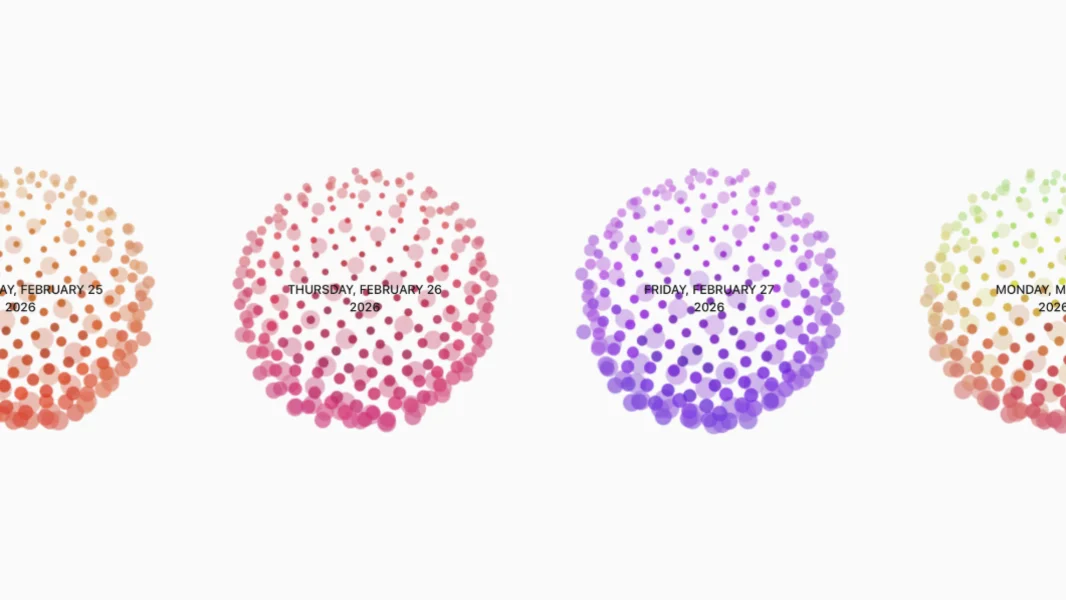
Why Your Sphere Looks Different Every Day
You record your entry. Ten seconds. The modal disappears. And the sphere — which was pale and still a moment ago — has changed.
A different color. A different quality to the way it moves when you press play. Something that feels, somehow, like it belongs to today specifically, in a way that yesterday’s sphere didn’t.
This isn’t random. Every sphere in your archive is shaped by two things: what you said, and how you said it. Understanding how that works changes what you notice when you look at your archive — and what you hear when you listen back.
Two Layers, Two Different Moments
The sphere is built in two distinct phases, at two different moments in time.
The first happens right after you record. The second happens while you listen.
This distinction matters, because it means the sphere isn’t a static image attached to an entry. It’s something that comes alive differently each time you play it back — shaped by the original recording, but animated anew each time you press play.
What Shapes the Color
Immediately after your recording is saved, Inner Dispatch analyzes what you said.
Not the words themselves, exactly — the emotional content carried by those words. The tone of what you expressed. Whether the entry carries something heavy or something light. Something anxious or something settled. Something that happened to you or something you’re looking forward to.
This analysis happens quietly in the background. By the time you press play, the sphere’s color has already been determined — a fixed value that belongs to this entry and won’t change on future listens.
The color exists on a spectrum. Entries that carry more weight — difficult emotions, tension, things unresolved — tend toward cooler, deeper tones. Entries that carry lightness — relief, warmth, something good — tend toward warmer ones. The exact mapping isn’t something Inner Dispatch explains, and that’s intentional. The color is an interpretation, not a label. You’re not being told “you were anxious today.” You’re being shown something, and left to recognize it or not.
What this means in practice: look at your archive across a few weeks and you’ll start to notice patterns without being able to fully explain them. A run of similar colors during a particular stretch. A shift that corresponds to something that changed. The sphere’s color is a visual record of your emotional life — imprecise, interpretive, but often more honest than the words you used to describe it.
What Shapes the Movement
The color is fixed at the moment of recording. The movement is different — it’s generated fresh every time you press play.
As your voice plays back, Inner Dispatch reads the acoustic qualities of the recording in real time: the energy in your voice, how quickly you’re speaking, the volume and rhythm of your words. These qualities drive the sphere’s animation — the speed of its rotation, the way the particles move, the brightness and size of the individual dots.
A recording made when you were speaking quickly, with energy, produces a sphere that moves with corresponding animation — more active, more luminous. A slow, quiet entry produces something stiller. A recording where your voice trails off at the end looks different from one where you finish with certainty.
None of this is visible until you press play. The sphere sits still — showing its color, holding its shape — and then comes to life as soon as the audio begins. When the recording ends, it stills again.
This is why the listening experience in Inner Dispatch feels different from simply hearing a voice memo. You’re not just hearing the entry. You’re watching it — a visual rendering of how you sounded, animated in sync with the actual audio.
Why No Two Spheres Are Identical
The combination of these two layers — fixed color from emotional content, live animation from acoustic qualities — means that every sphere is genuinely unique.
Two people could record the exact same sentence on the same day and end up with entirely different spheres. Their voices carry different energy, different pace, different emotional weight. The words are the same. The spheres are not.
Even you, recording the same kind of entry on two similar days, will produce two distinct spheres. The color might be close — similar emotional content, similar tone — but the movement will differ, because no two recordings of your voice are acoustically identical. Your pace is slightly different. Your energy is slightly different. The specific way you said something on a Tuesday is not the same as the way you said something similar on a Thursday.
This is what makes your archive genuinely yours, in a way that a written journal isn’t. A written journal captures what you said. The sphere captures something closer to how you were — the acoustic and emotional signature of a specific moment, rendered visually in a form that can’t be replicated or faked.
What to Look For When You Browse Your Archive
Once you understand what shapes each sphere, browsing your archive becomes a different kind of experience.
Notice runs of similar colors. A stretch of entries in the same general tone tells you something about that period — not what happened, but how it felt. You might recognize it immediately, or you might find yourself surprised by what you see.
Watch how the movement changes across entries. Play a few entries from different weeks back to back. Notice the difference in how the sphere animates — the difference in energy, pace, presence. You’re watching the range of how you’ve been across that span of time.
Pay attention to the outliers. An entry whose color looks different from everything around it stands out for a reason. Something was different that day. The sphere noticed, even if you’d forgotten.
Compare entries from similar days. Monday mornings recorded over several months might share something — or might show more variation than you’d expect. The sphere makes these comparisons visible in a way that reading entries wouldn’t.
What the Sphere Isn’t
It’s worth being clear about what the sphere doesn’t do.
It isn’t a mood tracker. There’s no score, no rating, no label that tells you how you were feeling. The color is an interpretation, not a diagnosis — and Inner Dispatch doesn’t explain its reasoning. Two entries that look similar might have been generated by very different emotional content. Two entries that look different might have come from days that felt similar to you.
It isn’t always accurate. Emotional content is genuinely difficult to read from a ten-second recording, and the sphere’s interpretation won’t always match how you remember the entry. That’s fine. The sphere is one lens, not the definitive account.
And it isn’t meant to be analyzed too precisely. The value isn’t in understanding exactly why today’s sphere is the color it is. The value is in looking at a week of spheres, or a month, or a year — and seeing something about that period that you couldn’t have articulated in words.
Your Next Step
The easiest way to understand what the sphere is doing is to record a few entries under different conditions and watch what changes.
Record once when you’re calm, at the end of a settled day. Record once when something is on your mind. Record once when you’re in a hurry, speaking quickly. Listen to each one and watch the sphere while your voice plays.
You’ll start to see the connection — not as a formula, but as something you recognize. That recognition is the point.
To understand how the sphere experience extends across your full archive — weeks, months, and a full year played in sequence — [Your Year in 60 Minutes: The Annual Replay Experience] covers what it feels like to watch your spheres move through an entire year.
This section contains affiliate links.
Go Deeper

You've been thinking about this long enough.
Ten seconds. Your voice. That's all it takes.
Inner Dispatch turns a single daily recording into something you can actually see - a living reflection of where you've been.
Start free. No writing required. →