How to Use Inner Dispatch for Your Year-End Review
Most year-end reviews start with a blank page and a question: What happened this year?
You sit down in late December, try to reconstruct twelve months from memory, and end up with a version of the year that’s been shaped by what’s most recent, most dramatic, or most emotionally charged. The ordinary days — the texture of an average Tuesday in March, the small wins in a difficult quarter, the way you felt in the weeks before something big changed — those things are gone. Memory doesn’t keep them.
If you’ve been recording in Inner Dispatch throughout the year, you have something different. Not notes you wrote, not a summary you drafted — your actual voice, from ordinary days, speaking honestly about what was happening. That’s the raw material for a review that reflects the year as it actually was, not just as you remember it now.
This article is about how to use that material.
Why Most Year-End Reviews Miss the Year
The standard year-end review format — list your goals, rate your progress, write down what you learned — produces a certain kind of reflection. Useful, but limited.
The problem is retrospective distortion. Looking back from December, the year tends to compress into its peaks and troughs: the promotion, the health scare, the trip, the difficult stretch in the fall. The ordinary middle — which was most of the year — gets flattened. You end up reviewing a highlight reel rather than a life.
There’s also the problem of emotional revision. How you feel about a period of your life changes depending on how it ended. A difficult six months that eventually led somewhere good gets recast as “a necessary challenge.” A good period followed by a setback gets remembered with more ambivalence than it deserved. The present shapes the past without you noticing.
A voice archive cuts through both problems. You can’t retrospectively edit what you said in March. The emotions in your voice from July are the emotions you actually had in July. The record is honest in a way that memory isn’t.
Before You Begin: What You Need
To use Inner Dispatch for a year-end review, you need two things.
An archive of recordings. The more consistently you’ve recorded throughout the year, the richer the review. But even a partial archive — recording three or four days a week, with some gaps — gives you more to work with than memory alone.
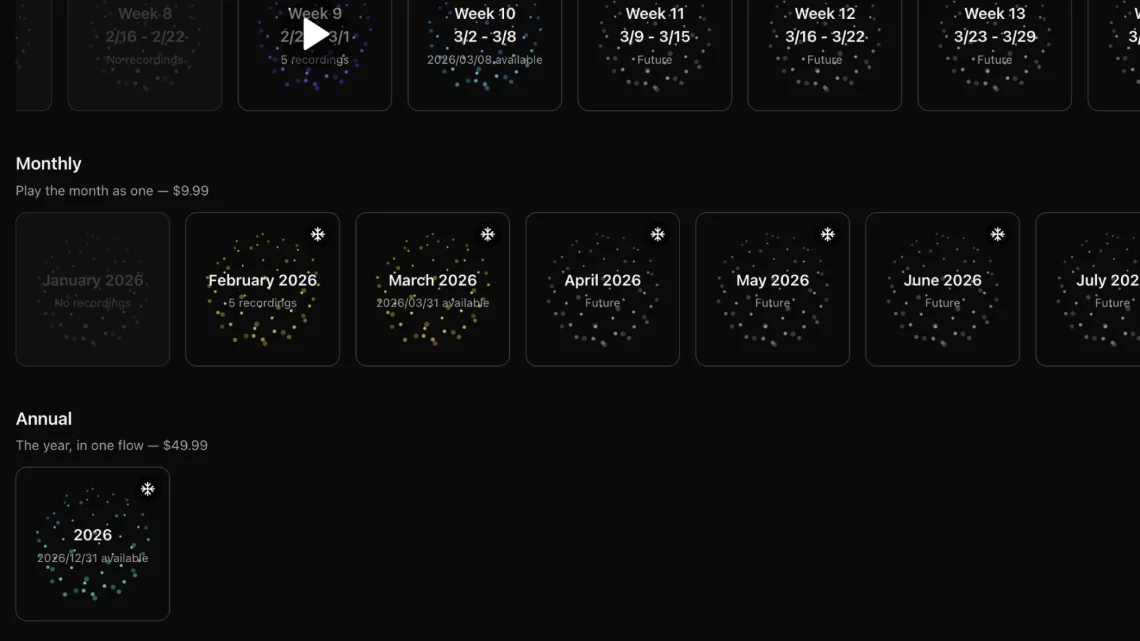
The Memory Plan, temporarily. The Annual Replay and full archive access require the Memory Plan. If you’ve been on the free plan all year, this is the moment to upgrade. Your entire archive is already stored — the Memory Plan simply unlocks it. You can cancel after your review if you prefer.
Everything else is optional. You don’t need a structured framework or a list of prompts. The recordings will provide most of what you need.
The Year-End Review Process
Step 1: The Full Listen
Set aside about an hour. Find somewhere you won’t be interrupted. Open Inner Dispatch and use the Annual Replay to move through the year chronologically.
Don’t take notes yet. Don’t stop to analyze. Just listen.
This first pass is about reorientation — getting back into the actual experience of the year rather than your current summary of it. You’ll hear entries you’d forgotten. Periods that felt enormous in the moment will pass in a few minutes of listening. Things you thought were minor will turn out to have taken up more space than you realized.
Let the year play out. There’s time to go back.
Step 2: Mark What Stands Out
On a second pass — or with a notebook open during the first — mark entries that catch your attention. Not necessarily the dramatic ones. The ones where something in your voice sounds different than expected. The entries that feel like they’re from a different chapter than the one you’re currently in. The moments where you can hear yourself working something out.
You’re looking for signal, not highlights. A low-energy entry from a Tuesday that turned out to be the week before a major shift. A recurring tone during a stretch you thought you were handling fine. The entries you don’t remember recording at all.
Step 3: Look at the Sphere Archive
Step back from the audio and look at the year visually. The Sphere archive gives you something a written journal can’t: an emotional weather map of the year. The colors, the patterns, the clusters.
Are there stretches of similar-colored Spheres? Points where the color shifts noticeably? A period you thought of as stable that looks more turbulent in the archive, or a stretch you remembered as hard that reads lighter than expected?
The Sphere isn’t a precise diagnostic tool — it’s an impression, not a measurement. But the visual pattern of a year of entries carries information that the audio alone doesn’t surface as easily.
Step 4: Name the Chapters
Most years have chapters — distinct periods with their own character, even if the boundaries weren’t visible while you were living them. After listening and looking at the visual archive, try to name yours.
Not “Q1” or “January through March.” Something that captures the actual quality of the period. The stretch before the decision. The month everything accelerated. The quiet part. After.
You don’t need many. Three or four chapters is usually enough to hold a year. The point is to replace the flat summary — “it was a hard year” or “things went pretty well” — with something more specific.
Step 5: The Three Questions
With the archive in mind and the chapters named, sit with three questions:
What was I actually carrying? Not what you thought you were dealing with at the time, but what the recordings suggest you were really carrying — the themes that kept coming back, the tone underneath the content.
What changed that I didn’t notice at the time? Look for the point in the archive where something shifted — your voice, your energy, the things you talked about — that you didn’t register as a transition while it was happening.
What do I want to bring forward? Not resolutions. Something more specific: a quality from a period of the year you want more of, an insight from the archive that you’d lose without writing it down, something you heard in your own voice that you want to remember.
These don’t need long answers. A few sentences each is enough. You’re not producing a report — you’re extracting what the year actually has to teach you before the memory of it fades further.
What Makes This Different from Other Year-End Reviews
The standard review asks you to evaluate the year from outside it. Inner Dispatch puts you back inside it.
Hearing your own voice from nine months ago is a different cognitive experience than reading notes from nine months ago. It’s harder to be abstractly optimistic about a period when you can hear how you sounded during it. It’s also harder to dismiss a period as purely difficult when you can hear the ordinary lightness that existed alongside the hard parts.
The review becomes less about judgment — did I have a good year, did I achieve my goals — and more about understanding. What was that period actually like? What was I actually like during it? What does the full shape of it look like from here?
Those are questions that only become answerable when the raw material is honest. A voice archive, recorded without performance or retrospective editing, is about as honest as self-documentation gets.
A Note on Partial Archives
Not everyone records every day. If your archive has gaps — weeks or months where you didn’t record — the review is still worth doing.
The entries you do have will tell you something true about the periods they cover. The gaps tell you something too: times when Inner Dispatch wasn’t a priority, which often correlates with times when you were either very overwhelmed or, sometimes, very absorbed in something that didn’t leave much room for reflection.
Work with what’s there. A partial map of a year is still a map.
Common Questions About Year-End Review with Inner Dispatch
When should I do my year-end review?
Anytime in the last few weeks of December or early January works well. Some people find it useful to do the review before the new year rather than after — when you’re still in the year rather than already oriented toward the next one. Either is fine. The recordings don’t expire.
How long does the Annual Replay take?
The Annual Replay is designed to move through a full year of recordings in roughly an hour, depending on how many entries you have. You’re not listening to every second of audio in real time — the replay is designed to be a navigable, continuous experience.
What if listening back is emotionally difficult?
It can be. Hearing your own voice from a hard period is sometimes harder than you expect. If something comes up, it’s okay to pause. The review doesn’t have to be done in one sitting. And if a particular stretch of the archive brings up something significant, that’s information worth sitting with rather than pushing through.
Do I need to do this every year?
No. The review is most valuable when the year had significant shape — when things actually changed, when you made decisions that mattered, when a chapter genuinely closed. Not every year has that. Some years are transitional in ways that are better reviewed from a slightly longer distance. Use the format when it fits the year you actually had.
Can I do a mid-year review instead?
Yes, and for some people a mid-year review is more useful than waiting for December. If a significant chapter closes in June — a project ends, a relationship changes, a period of sustained difficulty resolves — that’s a natural moment to use the archive, regardless of where it falls on the calendar.
The Year as It Actually Was
There’s a version of your year that exists in your memory — compressed, edited, colored by how things turned out. And there’s the version in the archive: ordinary days, honest voices, the actual quality of ordinary time.
The year-end review isn’t about deciding which version is true. Both are. But the archive version will fade faster, and it contains things the memory version won’t. The review is a way of visiting it before it becomes inaccessible.
If you’ve been recording, the material is already there. The milestone has arrived. That’s the moment the archive was built for.
Your Next Step
If you’ve been recording throughout the year and want to do this review, the Memory Plan unlocks your full archive immediately. Set aside an hour, put on headphones, and let the year play.
This section contains affiliate links.
Go Deeper
You've been thinking about this long enough.
Ten seconds. Your voice. That's all it takes.
Inner Dispatch turns a single daily recording into something you can actually see - a living reflection of where you've been.
Start free. No writing required. →