How to Listen Back to Your Entries (And Why It Matters)
Most people think of Inner Dispatch as a recording tool. Tap the microphone, speak for ten seconds, done. The archive grows. The practice continues.
But the recording is only half of what’s here.
The other half — the part that most people discover accidentally, somewhere in the second or third week — is listening back. Hearing your own voice from yesterday. From last Tuesday. From a month ago, if you’ve unlocked it. And noticing that the person speaking sounds both completely familiar and somehow slightly different from who you are right now.
That’s when Inner Dispatch stops being a habit and starts being something else.
How Playback Works
The playback controls sit at the bottom of the main screen, just to the left of the microphone button.
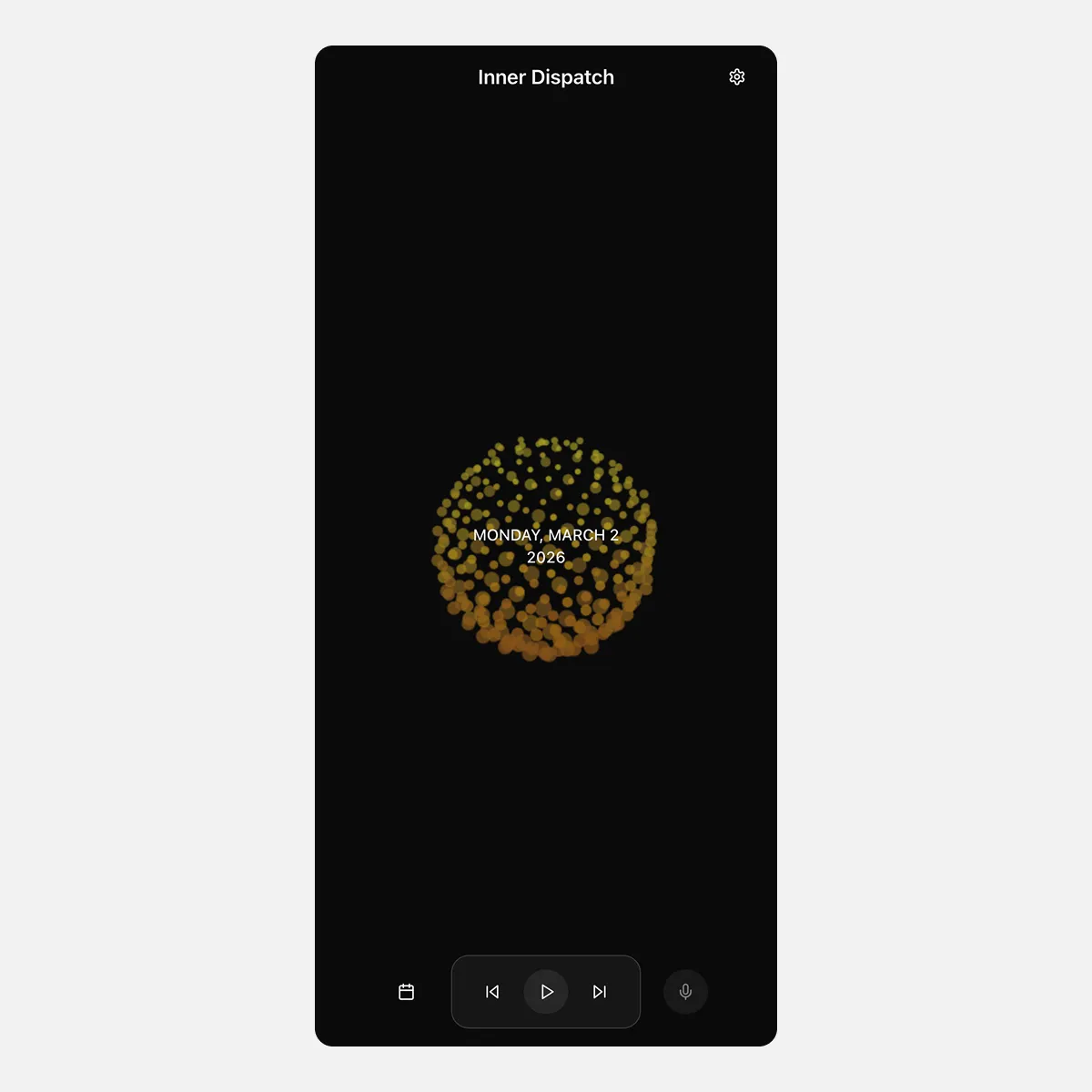
Three buttons: skip back, play, skip forward. The sphere at the center of the screen shows today’s entry by default — or the most recent entry if you haven’t recorded today yet.
Press play. The sphere comes to life — rotating, shifting, animated by the acoustic qualities of your voice in real time. Your recording plays. Ten seconds later, it ends. The sphere stills.
That’s the basic playback experience. From there, navigation is straightforward.
Skip back moves to the previous day’s entry. Skip forward moves to the next. You can move through your recent entries one at a time, in either direction, from the main screen without opening any other view.
For navigating to a specific date, tap the calendar icon at the bottom left. The calendar shows every day you’ve recorded as a colored dot. Tap any dot to jump directly to that entry.
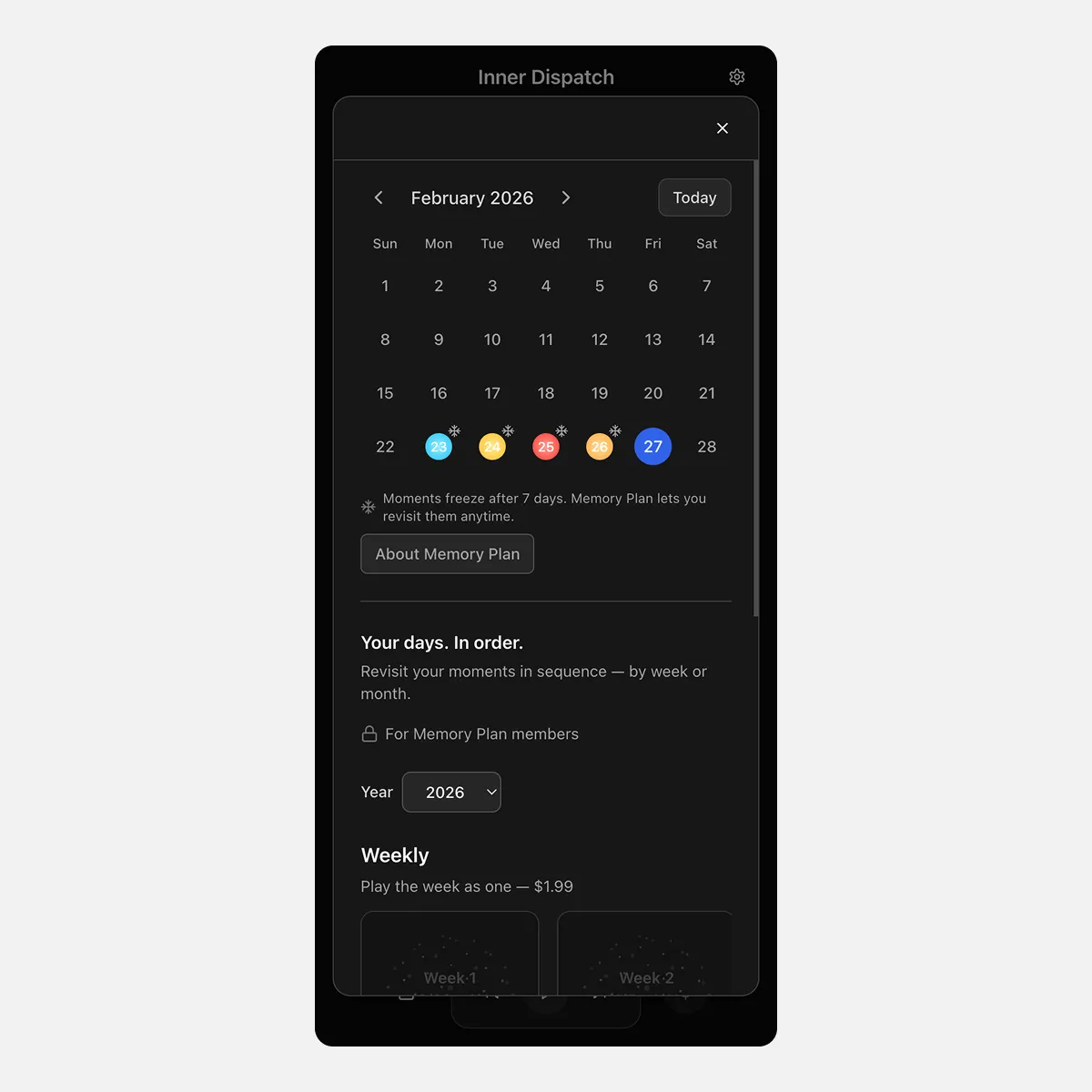
Entries from the last seven days are fully accessible. Entries older than seven days show a snowflake icon — frozen, but still visible in the calendar. Unlocking older entries requires the Memory Plan.
What Changes When You Listen Back
Recording an entry and listening back to it are different experiences in ways that are hard to predict until you’ve done both.
When you record, you’re in the moment. You’re responding to a situation, a feeling, a day. The words come from somewhere immediate — reactive, unedited, present.
When you listen back, you’re outside the moment. You’re hearing someone who was in a situation you’ve since moved through. And because it’s your own voice — not your words on a page, not a transcript, but the actual sound of how you spoke — the distance between then and now is more visceral than reading ever produces.
A few things consistently happen when people start listening back regularly:
You notice things your words didn’t say. The hesitation before a sentence. The way your voice drops at the end of something you were trying to sound casual about. The speed at which you spoke when you were actually fine versus when you were telling yourself you were fine. The voice carries information that the words don’t.
You remember things you’d already forgotten. Not dramatic things — the small details of a specific day. Where you were, what the background noise was, the particular quality of your mood on a Tuesday three weeks ago that you’d completely lost. The recording anchors the memory in a way that nothing else does.
You gain perspective on things that felt large at the time. Listening to an entry from two weeks ago about something that was worrying you — and hearing it from the other side, knowing how it resolved — produces a specific kind of reassurance. Not that everything always works out, but that the version of yourself who was worried about it was doing the best they could with what they had.
Building the Listening Habit
Recording daily is the easier habit to build, because it’s bounded. One action, ten seconds, done. Listening back is less bounded — you can listen for ten seconds or ten minutes, and it’s easy to skip.
A few approaches that work:
Listen to yesterday’s entry every morning before you record today’s. This takes twenty seconds total — ten to listen, ten to record — and creates a natural continuity between days. You hear who you were yesterday before you speak as who you are today. The comparison, even across a single day, is often more interesting than you’d expect.
At the end of each week, play the last seven days in sequence. Use the skip forward button to move through the week’s entries one by one. This takes about a minute if you recorded every day, less if you missed some. A week’s worth of entries played in order gives you a sense of the arc — the emotional texture of those seven days as a unit rather than as isolated moments.
When something shifts — good or bad — go back and find where it started. If you’ve been feeling noticeably different for the past few days, navigate back in the calendar and find the entry from before the shift. Listen from there forward. Often the recording will catch something that you didn’t consciously register at the time — the first hint of whatever changed, audible in your voice before your awareness caught up.
The Difference Between Listening and Reviewing
There’s a version of listening back that turns into self-monitoring — scrutinizing every entry for evidence of how you’re doing, tracking patterns, evaluating yourself against some internal standard. That version tends to make the practice feel like work.
The more useful version is closer to listening to music than to proofreading a document. You’re not looking for anything specific. You’re letting the entries come to you and noticing what you notice.
Some days a recording will feel unremarkable. Some days something will catch you — a phrase, a quality in your voice, a detail you’d forgotten — and it will feel like finding a photograph you didn’t know existed. You can’t predict which entries will do this. The ones that matter most are almost never the ones that felt significant when you recorded them.
This is why consistency matters more than quality. An archive of ordinary, unremarkable ten-second entries, listened back to over weeks and months, produces something that a collection of carefully crafted reflections doesn’t. The texture of a life, not the highlights.
What to Do When Listening Back Feels Uncomfortable
For many people, the first few times listening back to their own voice is genuinely uncomfortable. The voice sounds different than it does inside your head. The way you speak feels unfamiliar. There’s a self-consciousness that can make the experience feel more exposing than it should.
This passes, usually within the first week or two of regular listening. The voice becomes familiar. The self-consciousness fades. What replaces it is something closer to recognition — the voice as a reliable record of who you are, rather than as something strange and external.
If the discomfort persists past the early weeks, it often points to something more specific: an entry that captured something true that you’re not entirely comfortable with. That discomfort is worth sitting with rather than skipping past. The recording isn’t wrong. It just caught something honest.
Your Next Step
If you’ve been recording without listening back, try this: open Inner Dispatch right now and play yesterday’s entry.
Just one. Ten seconds. Watch the sphere move while you listen.
Then notice what you notice — about the voice, about the day, about the distance between who you were then and who you are right now, twenty-four hours later.
That’s the other half of the practice. It was there the whole time.
If you want to extend the listening experience across weeks, months, or a full year, [What Happens After 7 Days: The Memory Plan Explained] covers how to unlock older entries and play them in sequence.
This section contains affiliate links.
Go Deeper

You've been thinking about this long enough.
Ten seconds. Your voice. That's all it takes.
Inner Dispatch turns a single daily recording into something you can actually see - a living reflection of where you've been.
Start free. No writing required. →