How to Start Using Inner Dispatch: Your First Voice Entry
You’ve decided to start keeping a record of your life. Maybe you’ve tried journaling before — a notebook, an app, a notes file you abandoned after two weeks. Maybe you’ve never tried at all, because writing about your day has never felt like something you’d actually do.
Inner Dispatch works differently. There’s no blank page. There’s no pressure to write something meaningful. There’s just a microphone button, ten seconds, and your voice.
This guide walks you through everything from your first visit to your first completed entry — a process that takes under two minutes.
Why Ten Seconds Is All You Need
Most journaling tools are built for people who already love journaling. They offer rich text editors, tagging systems, mood trackers, and templates — all designed for someone who has time to sit down and reflect at length.
Inner Dispatch is built for everyone else.
The premise is disarmingly simple: speak one unfiltered moment every day for a year. Not a summary of your day. Not your feelings about your feelings. One moment. Ten seconds. Done.
This constraint isn’t a limitation — it’s the design. When you only have ten seconds, you stop trying to say the right thing and start saying the true thing. You capture the texture of a Tuesday afternoon in March rather than a polished retrospective you composed three hours later.
The result, over weeks and months, is something no written journal quite replicates: the actual sound of who you were.
The problem with longer-form journaling
Written journaling takes time, which means most people do it occasionally rather than daily. And occasional entries, however thoughtful, create gaps. You remember the big moments. You lose the ordinary ones — the commute where you figured something out, the quiet evening that somehow felt important, the version of yourself from six months ago that you’ve already half-forgotten.
Daily consistency matters more than depth. Inner Dispatch optimizes for the former.
Why voice captures what writing misses
There’s something that happens when you read your own handwriting from five years ago — a quality to the words that feels like time travel. Voice recording goes even further. Your tone, your pace, the slight hesitation before you say something honest — none of that survives transcription.
Inner Dispatch preserves the original signal. When you listen back to an entry from three months ago, you don’t just remember what you said. You hear who you were.
Getting Started: The Complete Walkthrough
The entire setup process takes less than two minutes. There’s no app to download, no preferences to configure, and no credit card required.
Step 1: Visit the Inner Dispatch website
Open your browser and go to the Inner Dispatch homepage.
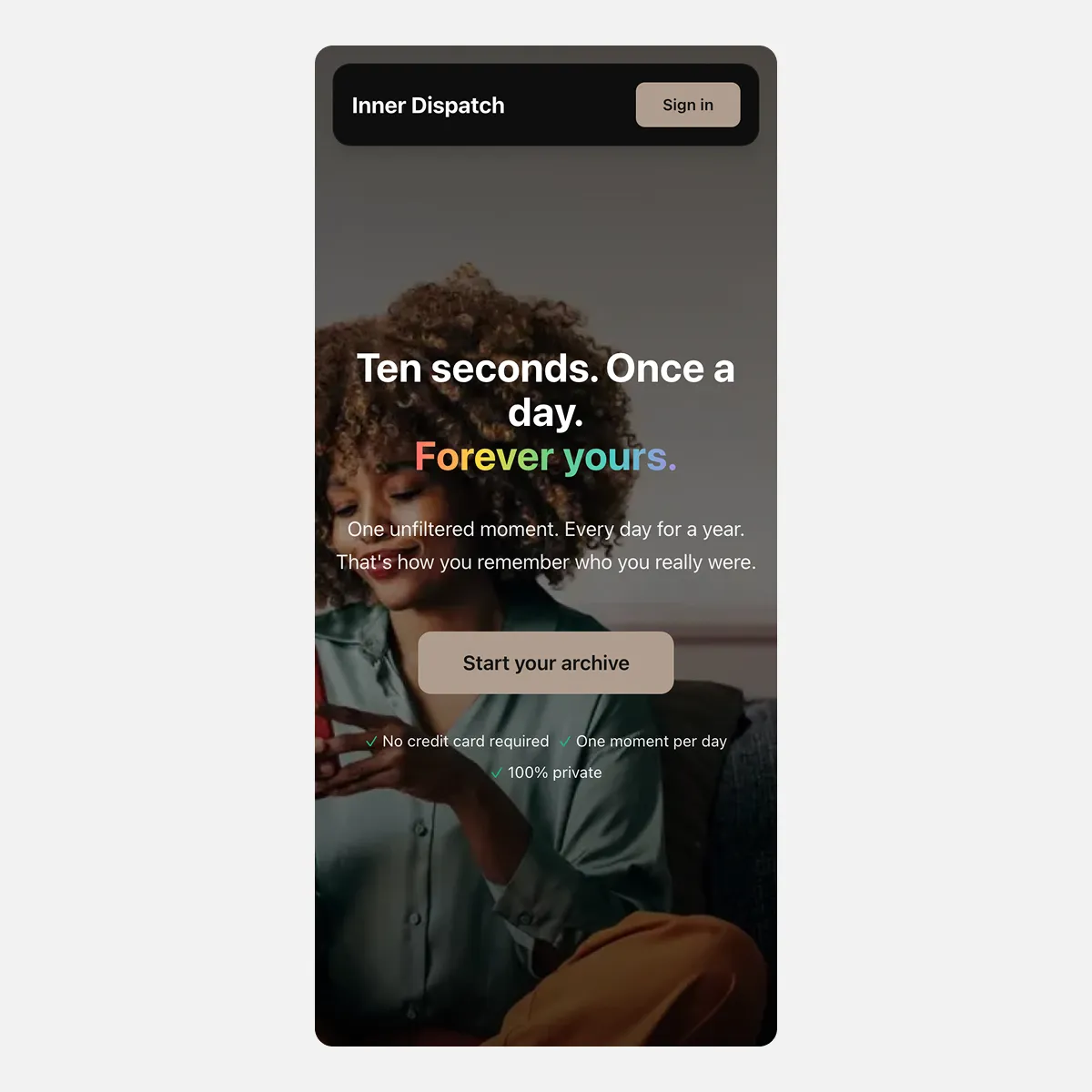
The homepage gives you everything you need to know in three lines: One unfiltered moment. Every day for a year. That’s how you remember who you really were.
When you’re ready, tap Start your archive.
You’ll also notice three small checkmarks below the button: No credit card required. One moment per day. 100% private. These aren’t decorative — they reflect real constraints built into the product. You can only record one entry per day, and your entries are private by default.
Step 2: Sign in with Google
Inner Dispatch uses Google authentication, which means there’s no new password to create and no email to verify.
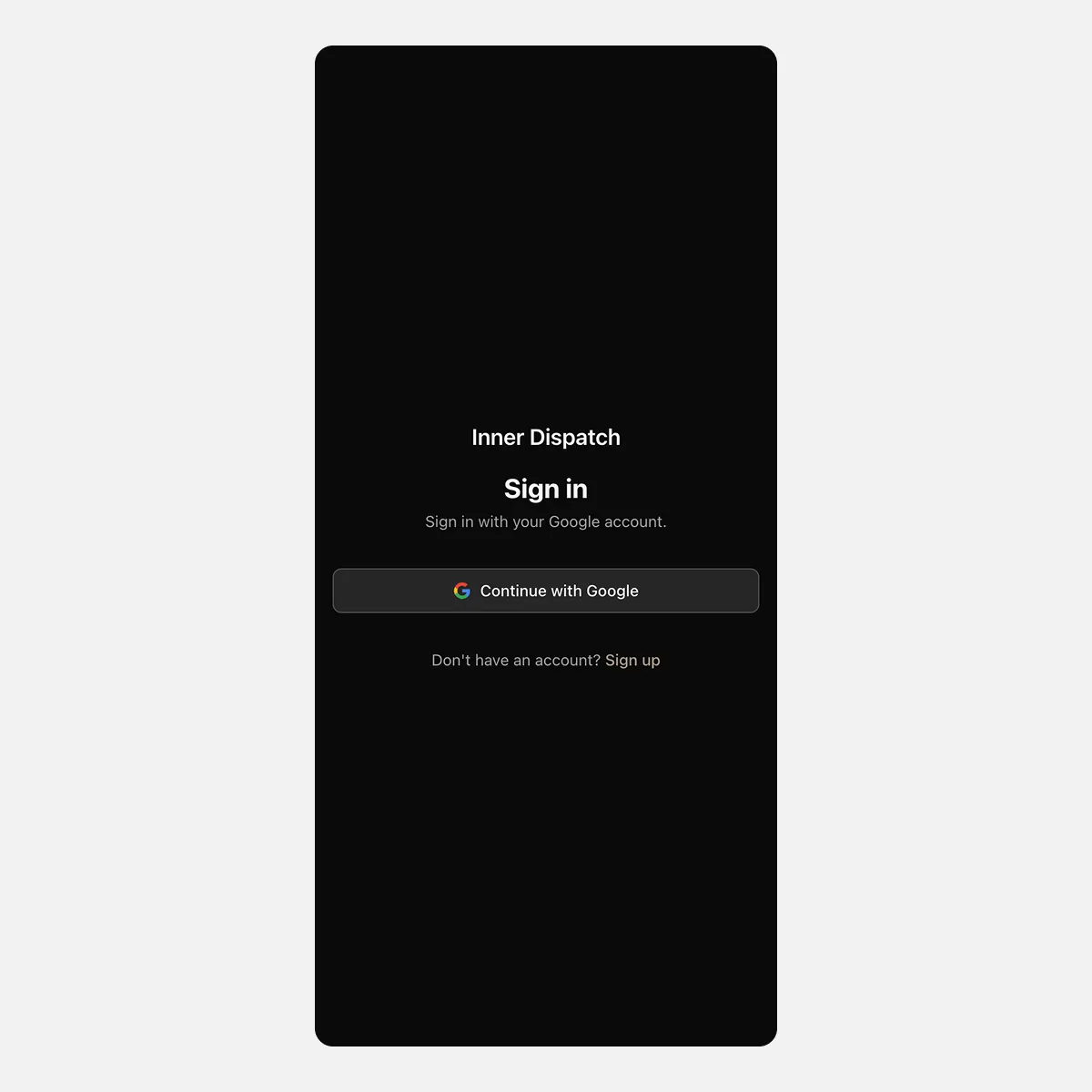
Tap Continue with Google, select your Google account from the prompt, and you’re in. The entire sign-in process takes about fifteen seconds.
This is the only time you’ll see this screen unless you sign out. On future visits, Inner Dispatch will recognize you automatically.
Step 3: Meet your archive
After signing in, you land on the main screen — a dark canvas with a softly glowing sphere of particles at the center, showing today’s date.
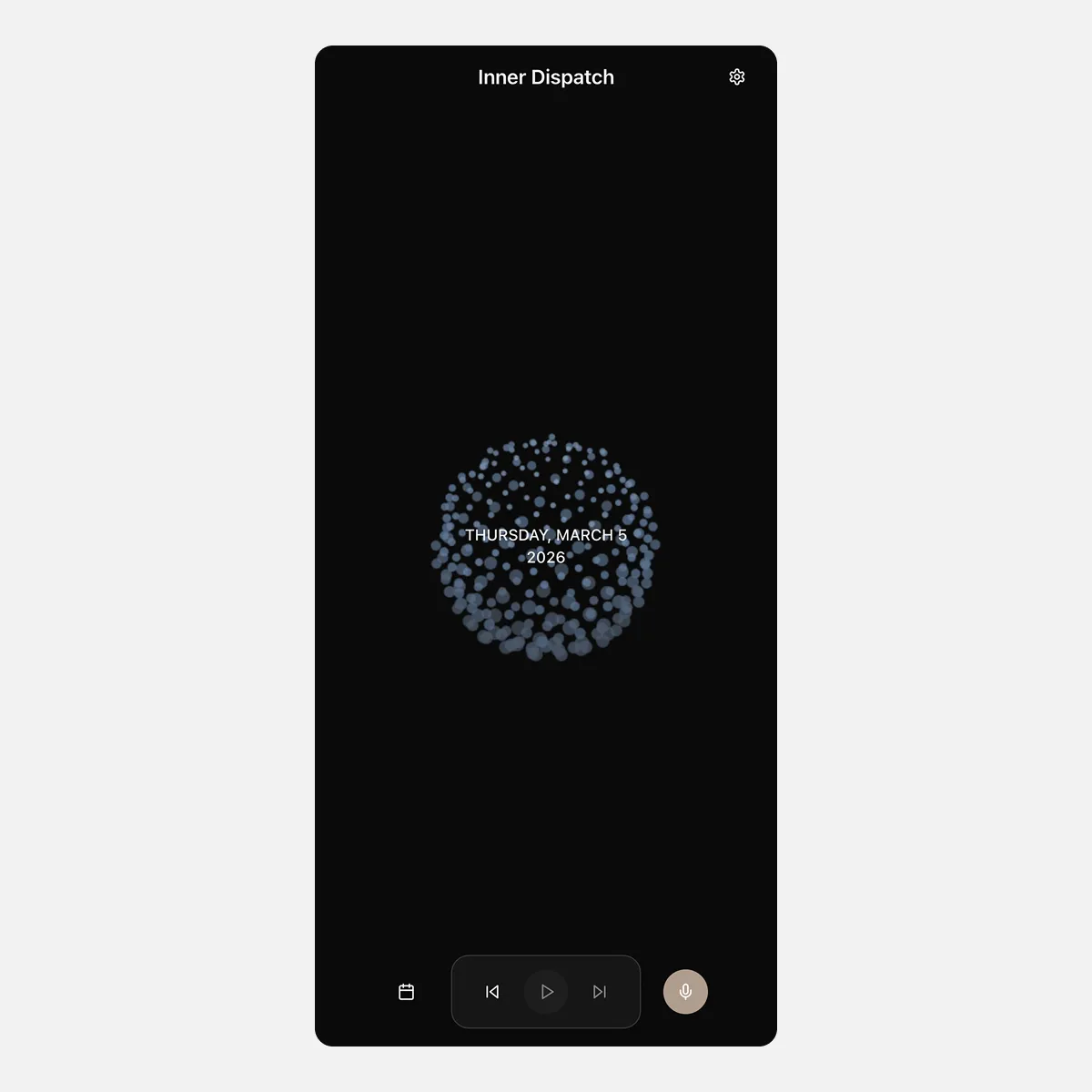
This sphere is your archive. Right now it’s blue-white, which means today’s entry hasn’t been recorded yet. At the bottom right, you’ll see a microphone button. That’s all you need to find.
Take a moment to notice what isn’t on this screen: no text fields, no prompts asking “how are you feeling today?”, no options or menus demanding your attention. The interface is designed to remove every possible reason to hesitate.
Step 4: Tap the microphone and wait
Tap the microphone button in the bottom right corner.
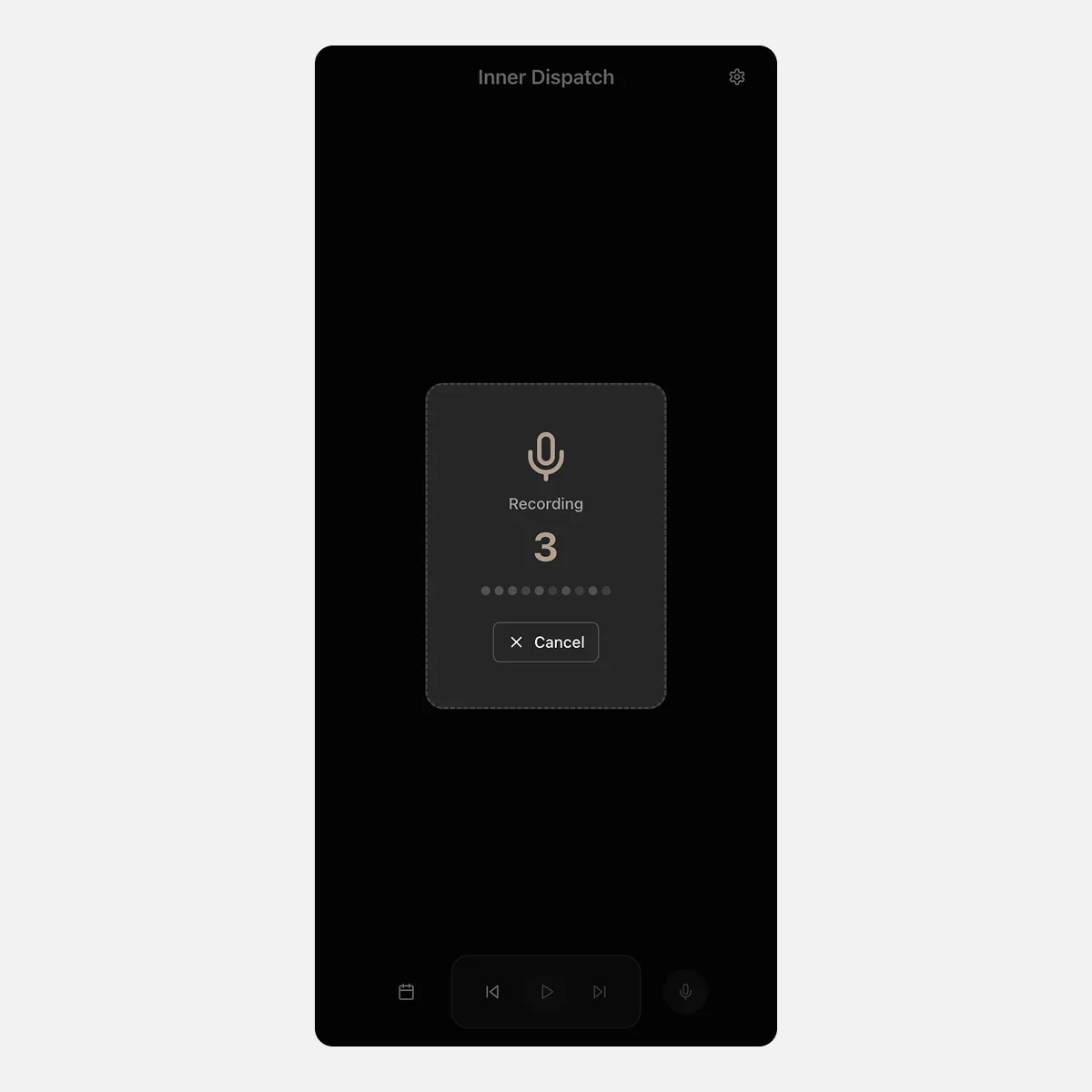
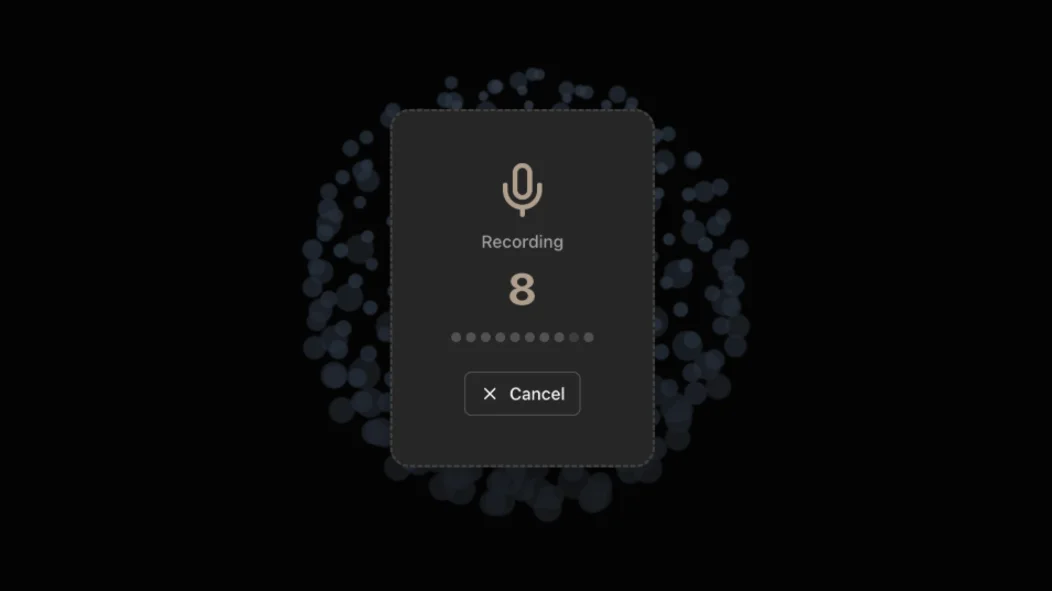
A recording modal appears with a five-second countdown. This brief pause is intentional — it gives you a moment to collect your thought before the recording begins. You don’t need to prepare anything elaborate. One sentence is enough. One feeling. One observation about where you are or what just happened.
The countdown runs: 5, 4, 3, 2, 1.
Step 5: Speak for ten seconds
When the countdown reaches zero, recording begins automatically. The modal shows a timer counting up to ten seconds, with a dot progress indicator tracking your time.
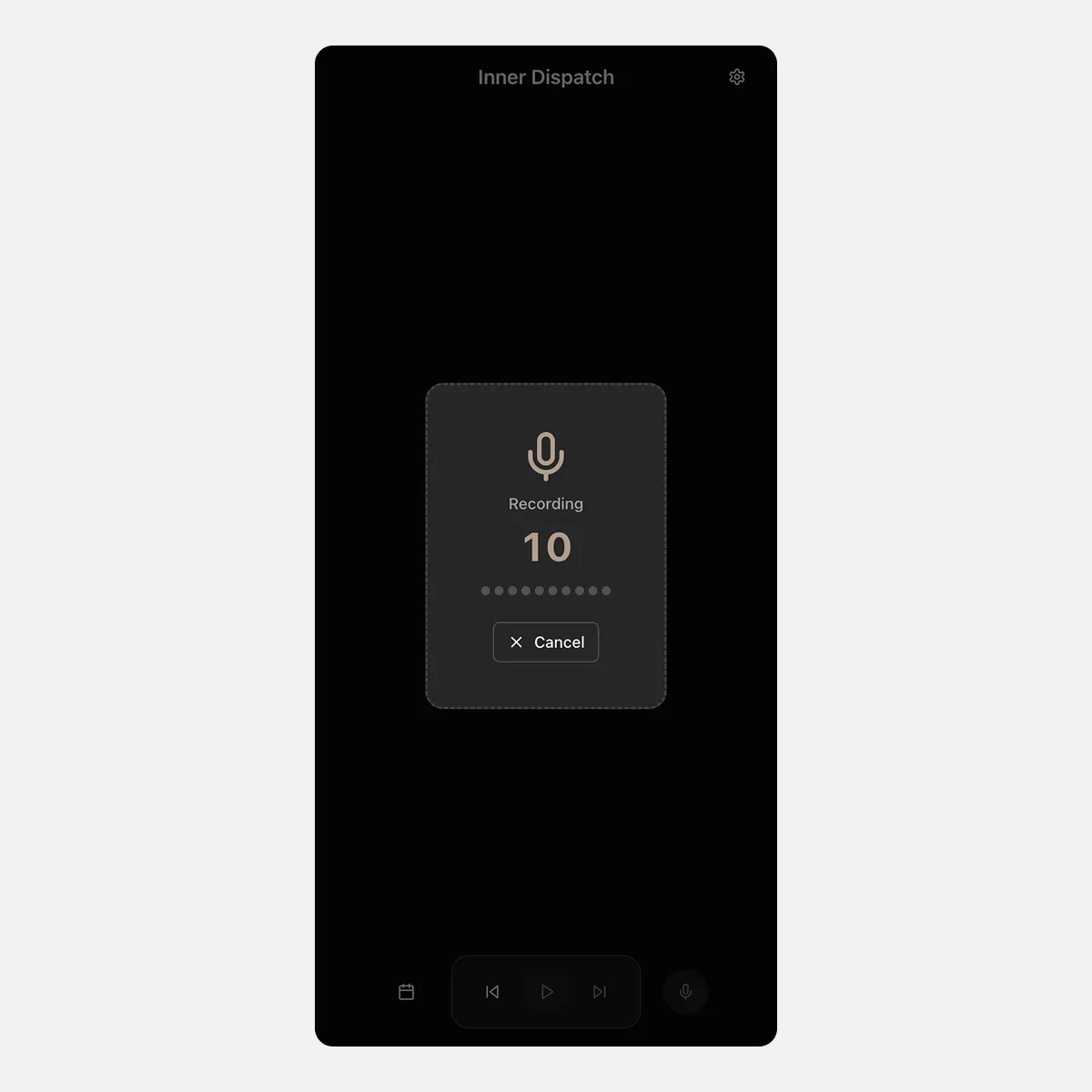
Say whatever comes to mind. You don’t need to fill the full ten seconds — but you can’t record more than ten seconds either. The recording stops automatically.
If you want to cancel and start over, tap Cancel at any time during the countdown or recording.
A few things that work well for a first entry: where you are right now, what you’re looking at, what’s on your mind, or simply how today felt. There’s no wrong answer. The value of your archive comes from honesty and consistency, not from saying something profound.
Step 6: Your entry is saved — and the sphere becomes yours
When the ten seconds are up, the recording modal disappears and you’re back on the main screen — but something has changed.
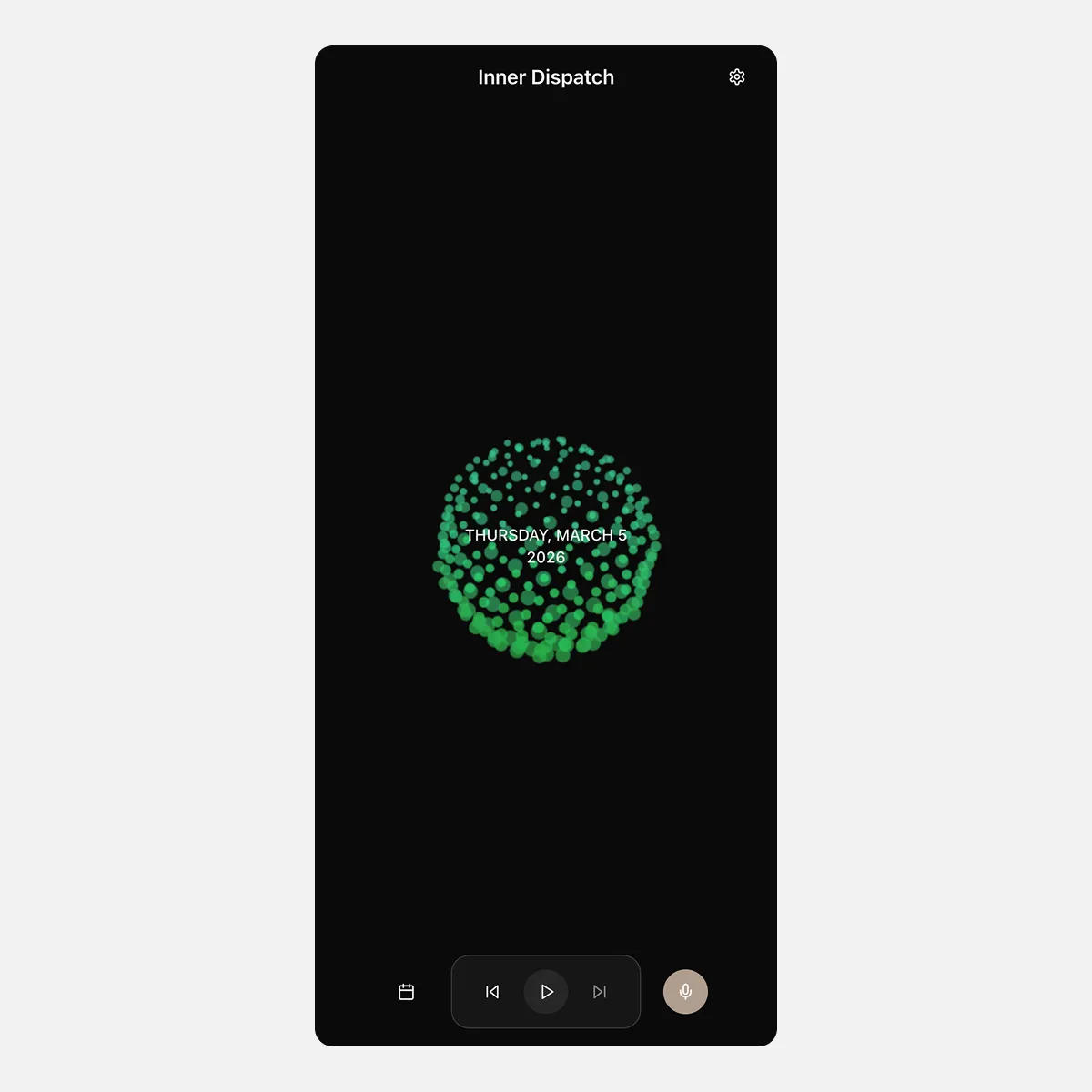
The sphere has changed color.
This is where Inner Dispatch does something no other journaling tool does. After your recording is saved, the app analyzes what you said — the emotional content of your words — and uses that to determine the color of your sphere. A color that reflects the tone of this particular entry, on this particular day. It won’t be explained to you. There’s no label that says “you sounded anxious” or “this entry was upbeat.” The color is just there, a quiet interpretation of something you said out loud.
Then, when you press play, something else happens. As your voice plays back, Inner Dispatch analyzes the acoustic qualities of your recording in real time — your pace, your energy, the volume and rhythm of your speech — and uses those to animate the sphere’s movement and texture. The particles shift. The sphere breathes differently depending on how you spoke.
The result is that no two spheres are exactly alike. Two people could say the exact same words and end up with completely different spheres, because their voices carry different weight, different speed, different feeling. Your sphere is a visual artifact of your voice — not just what you said, but how you said it.
Tap the play button to hear your entry back and watch the sphere move with your voice. For most people, this is the moment Inner Dispatch stops feeling like an app and starts feeling like something else.
What Happens Next
Your first entry is done. Here’s what to expect as you build your archive over the coming days and weeks.
The first week: building the reflex
The goal in your first week isn’t to record meaningful entries — it’s to make the habit automatic. Come back each day, tap the microphone, speak for ten seconds. That’s it.
You’ll probably notice the countdown becomes less awkward by day three or four. What to say will start arriving before you even open the app. Seeing the sphere change after each entry — a different color, a different movement — will start to feel like a small, quiet payoff.
Don’t worry about the quality of what you’re saying. Early entries are almost always mundane. That’s not a problem — that’s what daily life actually sounds like, and that’s exactly what’s worth keeping.
After a month: listening back
Around the thirty-day mark, try listening to your first week of entries in sequence. Use the back and forward controls at the bottom of the screen to move between entries.
Most people find this experience more affecting than they expected. Not because anything dramatic happened, but because a month of daily recordings creates a texture that no highlight reel can replicate. You’ll hear yourself in moods you’d forgotten, in places you’ve since left, saying things that turned out to matter more than you knew at the time.
This is the core value of Inner Dispatch: not the individual entries, but the accumulation.
The sphere as a record of each day
Every entry gets its own sphere — shaped by what you said and how you said it on that specific day. Browse back through older entries using the playback controls or the calendar view, and you’ll notice that each sphere looks and moves differently. A rushed entry from a busy Tuesday. A slow, quiet one recorded late at night. A particularly animated one from a day something unexpected happened.
The sphere is Inner Dispatch’s way of making your emotional history visible without reducing it to a number or a mood label. You don’t need to interpret it. You just recognize it — the way you might recognize your own handwriting.
Tips for Your First Two Weeks
Getting the habit to stick in the early days comes down to a few small decisions.
-
Record at the same time each day — Not because routine is inherently virtuous, but because a consistent trigger (finishing dinner, getting into bed, the morning commute) removes the decision of when. The habit attaches itself to something you already do.
-
Keep the tab open on your phone’s browser — Inner Dispatch is a web app, which means no notification system to remind you. The easiest workaround is to add it to your home screen or keep it pinned in a browser tab you visit daily.
-
Don’t re-record trying to say it better — You can cancel during recording and start again, but resist the urge to optimize. The value of your archive is authenticity, and your first instinct usually captures that better than your third attempt.
-
Speak to your future self, not an audience — This is private. Nobody else will hear it unless you share it. That permission to be unfiltered is worth using.
-
Let the ten-second limit do its job — When you feel like you have too much to say and ten seconds isn’t enough, notice that feeling. Then say the one most important thing. The constraint is a forcing function for honesty.
Common Questions
Do I have to record every single day?
No — there’s no penalty for missing days, and you can return after a break without losing your existing archive. That said, the product is designed around daily consistency, and the experience of listening back to an unbroken streak of entries is qualitatively different from a scattered collection. Missing a day is fine. Don’t let the missed day become a week.
Can I listen back to old entries at any time?
Yes. The playback controls at the bottom of the main screen let you move through your archive in sequence. The calendar icon on the bottom left gives you a view of your entries by date, so you can navigate to a specific day.
Is my voice data private?
Your entries are private by default. Inner Dispatch is built around the principle that these recordings are for you — not for analysis, advertising, or anyone else. The homepage is explicit about this: 100% private.
What if I don’t know what to say?
Say that. “I don’t know what to say right now” is a legitimate entry and, often, a surprisingly honest one. Alternatively: say where you are, describe what you can see, or name one thing that happened today. The bar is lower than you think, and that’s by design.
Can I record more than one entry per day?
No. One entry per day is a hard constraint, not a setting. This is intentional — Inner Dispatch is designed around a single daily moment, not a running log. If you want to capture more, try writing or using a different tool for longer reflection. The ten-second entry is a complement to deeper journaling practices, not a replacement.
Your Next Step
Your archive starts with a single entry.
Open Inner Dispatch tonight — or right now, if you have ten seconds — tap the microphone, and say one thing that’s true about this moment. Don’t think too hard about it. The sphere will take care of the rest.
Come back tomorrow and do it again.
That’s the whole practice. Everything else — the patterns you’ll notice, the version of yourself you’ll hear six months from now, the way the archive starts to feel like something real — comes from that one repeated decision.
If you’re curious about the research behind why short daily recordings are more effective than occasional long ones, take a look at [The Science Behind Why Short Daily Recordings Capture Memories Better]. And if you’re building a broader reflection practice alongside Inner Dispatch, [How to Build a Daily Habit That Actually Sticks] covers the habit-formation mechanics in depth.
This section contains affiliate links.
Go Deeper

You've been thinking about this long enough.
Ten seconds. Your voice. That's all it takes.
Inner Dispatch turns a single daily recording into something you can actually see - a living reflection of where you've been.
Start free. No writing required. →